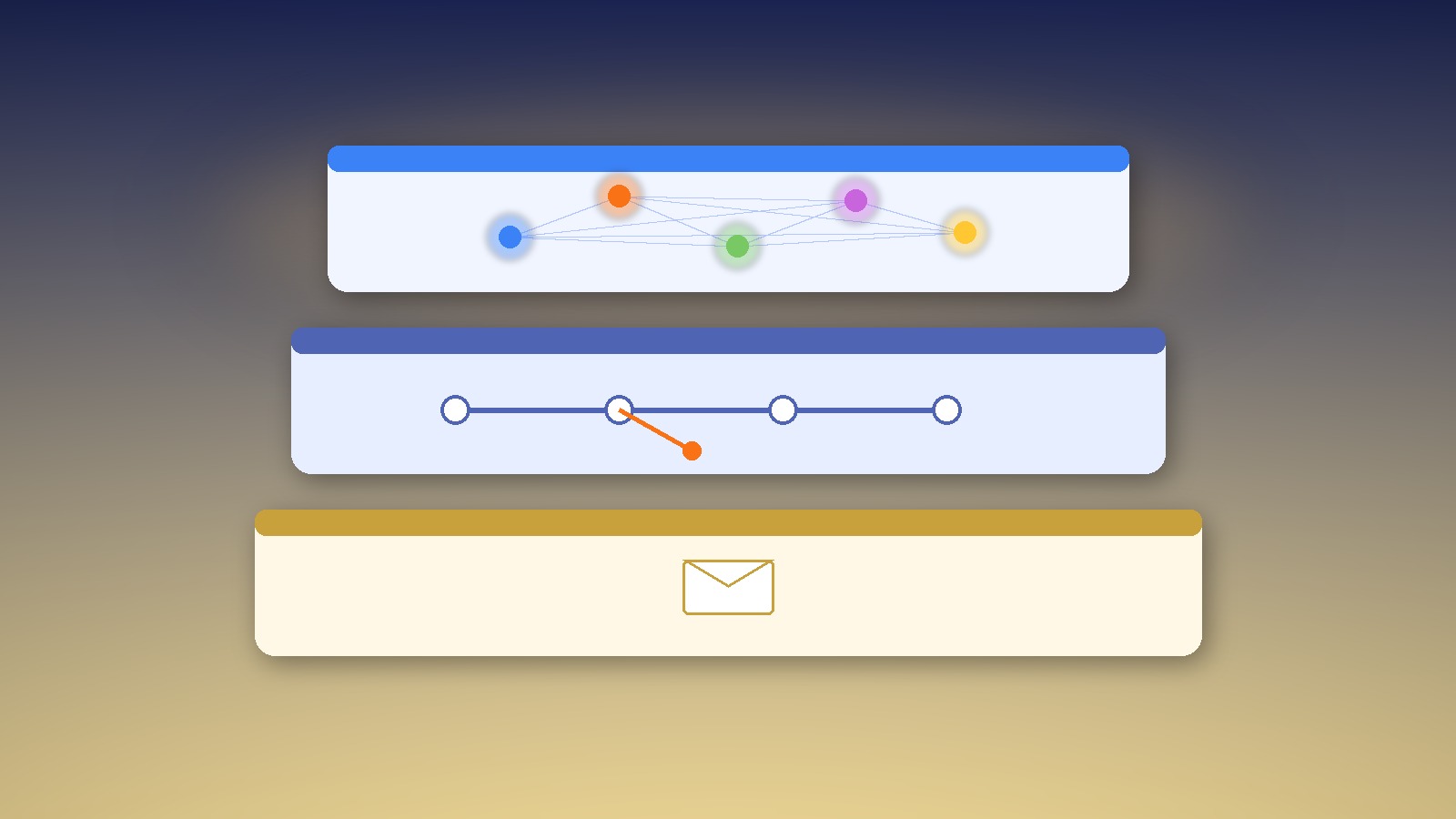
Adaptive journey vs rule-based journey: in-flight re-route vs fixed if/then
Adaptive vs rule-based journeys: comparison table, Iran win-back-after-DM vignette, guard checklist, Leadara mapping, FAQ.

Sara Moradi
Designs customer journeys and marketing automation campaigns for retention and lower churn.
September 18, 2026 · 7 min read
Also available in فارسی

What is the difference between an adaptive journey and a rule-based journey?
A rule-based journey locks paths at publish time and keeps walking them even if behavior changed. An adaptive journey can re-route mid-flight when live signals shift — for example skip win-back if they just purchased.
One-liner: rule-based = fixed if/then tracks; adaptive = in-flight re-route with the same human-set goals and guards. This is about whether the path updates while the person is inside — not about AI scoring flash.
Classic Iranian pain: win-back SMS after someone already bought via Instagram DM. An adaptive exit/goal check on order_completed stops the stale path.
Related frame: Marketing journey vs campaign. For re-engagement vs win-back naming, see Re-engagement vs winback campaign.
How does each journey style work?
Rule-based journey
At publish you draw: trigger → wait 3 days → email → wait 4 days → SMS. Unless you explicitly built an exit, the person may still get day-7 SMS after buying on day-2. Strength: readable, testable, easy to explain to compliance. Weakness: stale touches when reality moved.
Adaptive journey
The canvas still has human-defined nodes, but mid-flight checks re-evaluate live signals: purchase happened → exit; entered VIP → different branch; channel preference flipped → skip SMS. Strength: fewer embarrassing sends. Weakness: harder to reason about if every node becomes a black-box “AI decide.” Keep guards explicit.
Orchestration vs mapping: Journey orchestration vs journey mapping.
Comparison table
| Dimension | Rule-based | Adaptive |
|---|---|---|
| Path at publish | Fixed | Fixed skeleton + live re-checks |
| Mid-flight purchase | May still send later steps | Should exit / skip |
| Who sets rules | Marketer | Marketer (guards stay human) |
| Best for | Simple welcome, compliance-heavy flows | Win-back, multi-offer, long nurtures |
| Main risk | Stale messages | Opaque branching if over-automated |
| Leadara fit | Journeys with waits | Same journeys + goal/guard re-evals |
Iran vignette: win-back after DM purchase
“Sara” runs a handmade jewelry shop. A rule-based win-back waits 30 days of silence, then SMS 15% off. Many buyers pay card-to-card in Instagram DM; the site never sees order_completed unless ops enters it. They get the win-back anyway — trust burns.
Fix
- Ops posts a manual
order_completed(or equivalent) when DM payment clears. - Win-back journey goal: exit on any purchase event across channels.
- Re-check before each touch: if purchased or support ticket open → skip.
- Keep the 30-day silence rule as entry — adaptivity is the mid-flight guard, not deleting the rule.
Checklist: make a rule-based path “adaptive enough”
- Name the goal event that should kill the path.
- Re-evaluate that goal before every send node.
- Suppress conflicting journeys (cart vs win-back).
- Log why a branch skipped (reason codes for the team).
- Do not hide exits inside an unexplained AI node — keep if/then readable.
- Measure embarrassing-send rate (promo after purchase) monthly.
Leadara mapping: events, segments, journeys, email/SMS
- Events — live signals for mid-flight re-route (
order_completed, unsubscribe). - Segments — entry WHO (quiet 30d, engaged).
- Journeys — rule skeleton + goal/guard checks between waits.
- Email/SMS — actions that must respect the latest guard state.
- Governance — humans still set caps and consent; adaptive ≠ unsupervised.
Common mistakes
- Calling a drip “adaptive” when it never re-checks purchase
- Removing all rules and hoping a model routes everything
- Win-back overlapping an active cart journey
- No ops path for offline/DM purchases into events
- Measuring only sends completed, not sends prevented
FAQ
What is an adaptive journey vs a rule-based journey?
Rule-based locks the path at publish; adaptive re-routes mid-flight when live signals change, under human-set goals/guards.
Is adaptive the same as AI decisioning?
Not necessarily. Re-checking a purchase exit is adaptive and can be plain rules. AI may rank branches later — keep the distinction clear.
Can marketers build this without engineering?
Yes for guard logic on existing events; engineering still owns event taxonomy and DM/offline purchase capture.
What nodes make up a journey?
Trigger, wait/delay, branch, action (email/SMS), goal/exit — whether rule-based or adaptive.
Should every journey be adaptive?
Simple two-touch welcome can stay rule-based with one purchase exit. Long win-backs benefit most from mid-flight checks.
How does Leadara express adaptivity?
With journeys that re-evaluate events/segments as goals and guards between steps — not a mystical separate product mode.
What metric shows adaptivity working?
Drop in promo-after-purchase, stable STOP, equal or better conversion with fewer sends.
Bottom line and next step
Rule-based tracks keep walking; adaptive paths re-route when reality changes. This week, add a purchase-exit re-check before every win-back touch and wire DM/offline orders into order_completed.
Governance note for Iranian eCRM teams
Adaptive does not mean “the system may invent discounts.” Keep:
| Human-owned | Machine-ok |
|---|---|
| Max discount, quiet hours, consent | Skip node if goal met |
| Which journeys may overlap | Order of first-match branches |
| Event name contracts | Wait timing inside approved ranges |
Publish a one-page journey policy: every live journey lists its goal event and suppress partners. Review monthly next to the occasion calendar.
Three adaptivity levels a two-person team can ship this month
| Level | What | Example |
|---|---|---|
| 1 | Goal exit before every send | Purchase → kill win-back |
| 2 | Re-branch on a live segment | If VIP, offer without blanket discount |
| 3 | Channel pick with guards | If email unread and SMS consented, one SMS |
Start at level 1. Level 3 without frequency caps is dangerous. None require a separate “AI engine” if events and segments are healthy.
Cross-journey overlap table
| Journey A | Journey B | Rule |
|---|---|---|
| Cart | Win-back | Cart wins; win-back suppressed |
| Welcome | Occasion blast | New 7d suppressed from blast |
| Win-back | Product nurture | Shared max 1 promo touch / 7 days |
Cross-journey adaptivity matters as much as inside one canvas. Without a suppress matrix, “smart” is just noisy.
Before/after standup story
Before: 30 days quiet → 15% SMS; 12% of recipients had purchased that same week (DM or site).
After: order_completed check before send; 30% fewer sends; path conversion flat; lower STOP.
Tell that story with RPR and “sends prevented” — not with “adaptive journey toggled on.”
Design questions before publishing a journey
- What is the exit goal and which system emits it?
- If the goal fires mid-wait, what happens?
- Which other journeys must suppress?
- If the event arrives late (ops lag), does the path die or only skip the next touch?
- What did we deliberately leave rule-based so it stays readable?
30-day rollout for an Instagram-origin shop
Week 1: list every live journey and write a goal event beside each (even if not wired yet).
Week 2: agree with ops on DM/offline purchase capture — a simple form or manual event is enough.
Week 3: on win-back, add goal checks before email and before SMS; 10% holdout.
Week 4: compare promo-after-purchase and STOP to last month; lock the suppress matrix in the team note.
If week 2 stalls, you do not have real adaptivity — only a pretty canvas. Without multi-channel purchase events, mid-flight guards have nothing to see.
Boundary with “AI does everything”
If sales says “let the model decide when to discount,” point back at the governance table: max discount stays human. Adaptive means skip and branch on signals — not free coupon issuance. Keep that one-liner in the product brief and site FAQ so sales does not overpromise.
Related reading
- Marketing journey vs campaign — path vs blast
- Re-engagement vs winback campaign — quiet vs lost
- Journey orchestration vs journey mapping — run vs diagram